When Someone Ghosts You: Reclaiming Your Power After Being Left Without Answers
Disclosure: This page contains affiliate links. As an Amazon Associate, I earn from qualifying purchases. If you purchase through these links, I may earn a small commission at no additional cost to you. I only recommend products I genuinely believe will support your spiritual practice.
There is a particular kind of hurt that comes from being ghosted by someone you never imagined would disappear.

Not a stranger. Not someone you barely knew.
A friend. Someone you trusted. Someone you considered family.
And suddenly, there is silence.
No explanation. No conversation. No goodbye.
Just unanswered messages and the uncomfortable realization that a relationship you believed was real may no longer exist.
I've experienced that kind of silence myself. And one of the hardest parts wasn't simply losing the person. It was being left with all the questions.
What did I do?
Did I say something wrong?
Why wasn't I worth an explanation?
Should I reach out again?
Should I let it go?
Was the relationship ever what I thought it was?
When someone disappears from your life without an explanation, it can feel as though they've left you with the responsibility of figuring out what happened.
But here's something I've had to remind myself:
Someone else's silence is not a measure of your worth.
And sometimes, reclaiming your power begins with accepting that the answer you wanted may never come.
Ghosting is also the "I'm so busy!"
How many times have you heard that line?
"We'll have to get together soon! I've just been so busy!"
Or you try to plan something and everyday you suggest is already filled and they're like:
"It's okay. We'll figure something out."
Or how about the "I'll reach out!"
And they don't.
That's another form of ghosting.
And honestly, I don't know which one hurts more. The one where someone disappears. Or the one where they are still around, but just not around because they are "too busy" for you, but not for other people.
Sometimes the hardest part isn't realizing that someone stopped reaching out. It's realizing how long you were the one keeping the relationship alive.
Ghosting Doesn't Only Hurt Because Someone Is Gone
When we talk about ghosting, we often think about dating. But friends can ghost us too.
People we've known for years can become strangers. And sometimes, the people we considered family are the ones whose absence hurts the most.
That kind of loss can be difficult to explain.
Because you're not necessarily grieving a relationship that had a clear ending. You're grieving a relationship that may have ended without your understanding of why.
You may still have memories. You may still care about the person. You may still remember the good things.
And yet, something has changed.
Sometimes we're not only grieving the person. We're grieving the story we thought we were living.
We thought they were our friend.
We thought they were family.
We thought they would be there.
And discovering that our understanding of the relationship wasn't shared by the other person can be its own kind of heartbreak.
That doesn't mean every memory was fake. It doesn't mean you were foolish for caring.
It means you were a person who believed in a relationship.
And caring about someone is not something you need to apologize for.
When You Don't Get an Explanation
One of the hardest things about ghosting is that our minds want to solve it.
We replay conversations. We look for something we might have missed. We wonder whether we should send another message. Sometimes we go over the whole relationship in our minds and question everything.
Sometimes we want to know what happened because we want to know what to do next.
But sometimes, we want an explanation because we believe we can't move forward without one.
And those are not necessarily the same thing.
There is a difference between saying:
"I would like to understand what happened."
and:
"I cannot heal until this person explains themselves."
The first is understandable.
The second can leave your healing in someone else's hands.
And that is where I think tarot can offer something valuable.
Not because the cards can tell us exactly why someone ghosted us.
Not because they can reveal another person's private thoughts.
But because they can help us turn the questions inward, not in the sense of blaming ourselves, but in the sense of asking: What do I need to understand about myself now?
When someone ghosts us, that is on them. What we do with it is on us.
Let’s take a look at a few tarot cards and how we can use them to reclaim our power. Pictures are from the Cosmic Tarot Deck.
The High Priestess: Trust What You Already Know
The High Priestess is one of the first cards I think of when it comes to ghosting.
She reminds us that there is a difference between knowing something and having every detail explained.

When someone disappears, we often want information desperately. We want to know why.
But sometimes there isn't information available to us. The person just left without a word.
And sometimes, even if we received an explanation, it wouldn't change what happened.
The High Priestess invites us to listen inward.
Not to every fearful thought.
Not to every imagined explanation.
But to the quiet knowing that can emerge when we stop trying to force an answer.
There is a difference between intuition telling you:
"Something about this relationship doesn't feel right anymore."
and anxiety demanding:
"I need to solve this mystery before I can move forward."
That distinction matters.
Because trusting your intuition doesn't mean assuming you know everything about another person's motives.
It means trusting yourself to recognize what you experienced and decide what you need.
If you’re questioning whether something is intuition or anxiety, I discuss this more in my blog Intuition vs. Anxiety: 9 Clear Ways to Tell the Difference
You can acknowledge that something changed without knowing exactly why. And remember, you may never know why. And that’s okay.
The Queen of Swords: Boundaries Are Not Cruelty
The Queen of Swords is another card I would bring into this conversation.
She reminds us that compassion and boundaries can exist together.
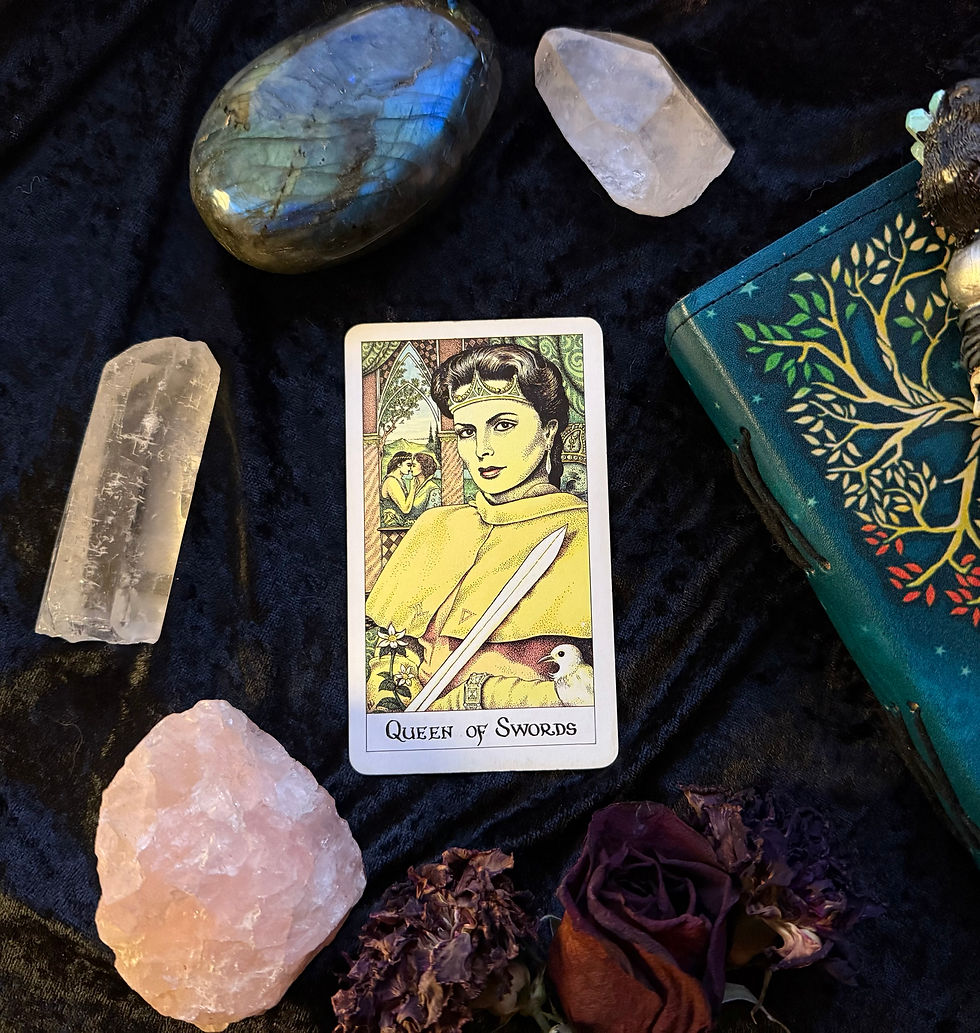
You can care about someone and still decide that their behavior is not something you want to continue accepting.
You can miss someone and still choose not to keep reaching out.
You can wish someone well and still recognize that the relationship is no longer healthy for you.
And you don't have to become cold to do that.
Sometimes reclaiming your power means sending one final message.
Sometimes it means sending nothing at all.
The point isn't to follow a universal rule.
The point is to make a choice that respects your own dignity.
Boundaries are not punishment. They are a way of deciding what you are willing to participate in and what you are willing to accept. Boundaries are a way to protect yourself.
And if someone chooses not to communicate with you, you are allowed to stop making communication your responsibility.
The Three of Swords: Let Yourself Grieve
This is the part I think we sometimes skip when we talk about empowerment.
We want to get to the lesson.

We want to get to the healing.
We want to get to the part where we say, "Their loss."
But sometimes, you're just hurt.
And that's okay.
Being ghosted can be a genuine loss. You may grieve them as if they died. Because, well, something did. They may still be alive and well, but the relationship is gone and that is grief you may need to work through.
You may miss the person. You may miss the conversations. You may miss the version of yourself that existed in that relationship.
You may even miss the future you imagined having with them.
And you don't have to pretend that none of that mattered.
The Three of Swords reminds us that grief is not weakness.
It is not a failure to move on.
It is not proof that you're stuck.
Sometimes, healing begins with simply allowing yourself to say: "This hurt me." Without immediately trying to turn it into a lesson. Without blaming yourself.
Without deciding that you should have known better.
You can be grateful for what a relationship once was and still grieve what it has become.
That is okay. Allow yourself to feel and to grieve.
I find in those moments journaling helps me. I don’t have to worry about what I say to someone. I can put all of my feelings into words on paper that no one, but myself will ever see. That is freeing.
I write. A lot. And this is one of my favorite journals that I use because it's witchy and inexpensive: One of my favorite Witchy Journals
Strength: Don't Let Their Silence Define You
Strength is not about pretending you don't care.
It is not about becoming someone who never gets hurt.
And it is not about proving that you are stronger than the person who left.

Strength is the ability to feel something deeply without allowing it to determine your worth.
You can be hurt and still choose not to chase.
You can be disappointed and still choose not to retaliate.
You can miss someone and still choose to protect your peace.
And sometimes, the strongest thing you can do is stop asking yourself what you could have done differently and start asking: What do I need now? And really listen to yourself.
Maybe you need to grieve.
Maybe you need to set a boundary.
Maybe you need to stop checking your phone.
Maybe you need to talk to someone who makes you feel seen.
Maybe you need to remind yourself that being left does not mean you are unlovable.
Whatever it is, you are allowed to take care of yourself. You are strong. And if they chose to ghost you, you can choose to be strong and carry on.
The Star: You Are Still Whole
The Star is the final card we’ll take a look at. And it’s fitting because it represents hope and healing.
Because after all the questions, all the uncertainty, and all the hurt, there is still you.

The person who cared.
The person who showed up.
The person who tried.
The person who is still here.
Someone leaving does not erase the love you gave. And it doesn’t diminish your worth.
It does not erase the memories you shared.
It does not erase the good things you brought into the relationship.
And it does not mean you have to become less open, less loving, or less yourself.
Healing doesn't necessarily mean you stop caring.
Sometimes it means you stop allowing the absence of someone else to determine how you feel about yourself.
You are still whole, even when a relationship is no longer part of your life.
And maybe that relationship was meant to end. Maybe you were giving so much and not appreciated and it’s the universe’s way of taking that weight off of your shoulders.
Finding Closure When You Never Got an Explanation
I used to think closure had to come from a conversation.
From someone explaining what happened. From knowing the “why” behind things.
From hearing the words that would finally make everything make sense.
And sometimes, that kind of conversation is possible.
But sometimes it isn't. Often it isn’t.
Sometimes the person doesn't want to talk.
Sometimes they don't know how to explain themselves.
Sometimes they have their own reasons for leaving that we may never understand.
And sometimes, we have to accept that the conversation we wanted may never happen.
That doesn't mean we have to pretend we're okay with it.
It means we can stop making our healing dependent on something we cannot control.
Closure doesn't always come from a conversation. Sometimes it comes from deciding that you no longer need one.
That doesn't mean you stop caring.
It means you stop waiting for someone else to give you permission to move forward.
And I think that's where reclaiming your power begins.
Not with anger.
Not with revenge.
Not with proving that you were right.
But with the quiet decision:
"I can be hurt by what happened without allowing it to define me."
A Tarot Spread for When Someone Ghosts You
If you're working through the loss of a friendship or relationship, you might find it helpful to sit with your cards and do a reading.

I work with this simple 7-card spread during times like this.
Here’s how I lay them out and what I ask:
Card 1: What am I grieving?
Card 2: What am I having difficulty accepting?
Card 3: What is my intuition trying to tell me?
Card 4: What boundary do I need to honor?
Card 5: What do I need to release?
Card 6: How can I reclaim my power?
Card 7: What is waiting for me beyond this experience?
This spread isn't designed to uncover why someone ghosted you or predict whether they'll return.
It's designed to bring the focus back to the one person whose healing you can actually influence:
You.
Take your time when you do this reading. Sit with the cards for a bit. Listen to your first impressions and record it in your tarot journal.
A Final Thought
If you've been ghosted by someone you loved, I hope you know that your hurt is valid.
You don't have to minimize it because someone else might think you should be over it by now.
You don't have to pretend the relationship didn't matter.
And you don't have to keep reaching out to someone who has chosen not to respond.
You are allowed to grieve.
You are allowed to have questions.
You are allowed to miss them.
And you are allowed to move forward without having every answer.
Their silence may have left you with questions, but it doesn't get to define your worth.
Sometimes, reclaiming your power begins with accepting that the answer you wanted may never come.
And sometimes, that is where your healing begins.
You may also enjoy:


Comments